.svg)

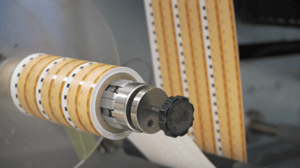
Grandma’s gotten out of the hospital, but you don’t know how to reapply adhesive patches for her heart monitor. What’s more, there are no visual markers, clear peel points, or instructions to guide you through the process.
Yeesh… talk about a nerve-racking scenario.
When you’re designing adhesive components, it’s easy to focus solely on performance and manufacturing. However, even the best design can fail without user instructions.
At Strouse, we’ve helped develop thousands of adhesive components from early concept through full-scale production.
In this article, we will discuss simple adhesive design strategies to help your end customers understand and apply the part correctly.
Design Tips for the End-User Application
Although you might be hesitant to alter your design, we’ve found that small changes often improve the application significantly without incurring much, if any, additional cost.

1. PRINT ON THE PRODUCT ITSELF
Printing allows you to add helpful visual cues, like arrows indicating the peel direction, icons showing where to apply pressure, or text guiding users through the application process.
For example, products such as medical patches and wearable devices rely on users following the steps in the correct order to ensure accurate placement.
A full-service converter can integrate printing directly into the converting process, allowing you to add visual instructions to your design without introducing additional manufacturing steps. Of course, printing isn’t always the most cost-effective option for every project.
2. USE DESIGN FEATURES AS VISUAL CUES
Rather than, or in addition to, printing on a part, many converters use features like tabs or extended liners to indicate how a part is properly used.
Strouse once worked with a medical device company on a wearable component that had multiple liners. During development, we recommended using a split back liner on one section of the part to provide a visual cue for where to peel. This ultimately made the product easier to apply without the additional cost of printing or labeling.
3. CREATING AN IFU TO TELL THE WHOLE STORY
Instruction For Use, or IFU, is the charter document that explains how the part’s directions relate to the application of the product. For example, Grandma might not know that the arrows on her heart electrodes indicate which way to attach the electrodes. The IFU is the document that will help explain it in a way that might not otherwise be obtainable.
Why Clear Application Information Matters
In medical applications, there is no room for ambiguity: unclear product instructions or design cues may put patients at risk or trigger emergencies.
Even in non-emergency products, information accuracy is often key to a functional product. Products that rely on precise placement or adhesive contact to function are commonly applied incorrectly by users without instructions. In this case, the product itself may work perfectly, but the lack of a tutorial has caused the failure.
By designing clear visual cues and intuitive application steps into the product itself, you dramatically reduce the chances of incorrect use and help ensure consistent results for every user. Your product can scale smoothly as production grows, because fewer application errors mean fewer complaints, returns, and customer support issues.
Why End-Use Design Should Start During Converting
Working with an experienced converter early in the design process can make a huge difference in having a product that works as intended.
When a converter is involved early in the design process, they can help evaluate:
- The part itself
- The requirements of the product
- The overall application process
Once they understand those factors, they can recommend design adjustments that improve both manufacturability and usability, such as:
- Adding intuitive peel tabs
- Choosing liners that create a logical application sequence
- Integrating printed instructions directly into the converting process
- Adjusting material layers to improve the part's handling during application
Designing for both manufacturing and end use creates products that are easier to produce and apply with reliable performance.

If you’re interested in learning more about how working with a converter can improve part manufacturability and usability, reach out to discuss your project.
Strouse has been manufacturing parts nearly every day for the past 40 years. These experiences have allowed us to observe what works well in the real world and what tends to cause problems for users.
To learn more about product end use, reach out or explore the resources in our Learning Center.