.svg)

Picture this.
Your product arrives in half the time with significantly fewer errors, and requesting status updates becomes as easy as one phone call.
Although this might sound like a fantasy (and a pretty good one at that), these results are commonly observed when businesses invest in a one-pass production process.
As a matter of fact, we’ve helped customers save tens of thousands of dollars by adapting their current production chain to a single press run.
One-pass production can be challenging to integrate, so stick with us as we explain how it increases productivity and when it might suit your process.
What is a One-pass Production Process?
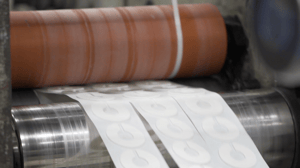
Depending on the solution, a product design may require laminating, die cutting, printing, packaging, and more. However, while your project may require many individual steps, those steps don’t necessarily need to run on separate machines.
How Does One-pass Production Improve Your Manufacturing Process?
.png?width=1800&height=1200&name=One-Pass%20Production%20and%20Contamination%20(8).png)
.png?width=1800&height=1200&name=One-Pass%20Production%20and%20Contamination%20(9).png)
One-pass production (pictured above) is an example of supplier consolidation.

1. SIMPLIFYING COMMUNICATION
Don’t you love shipping, billing, and product delays? You may even wish to deal with them more (unlikely).
With one-pass production, you only need to worry about keeping in touch with your contacts at a single company. That’ll help reduce the number of emails in your inbox for sure.
2. SIMPLIFYING TRANSPORTATION
When you use multiple facilities for different production steps, you’re stuck with unnecessary lead times and the burden of managing and paying for various shipments. A one-pass production process can help simplify an inflated shipping system down to the minimal number of involved parties.
3. REMOVING AREAS FOR ERROR
An increased number of machine passes creates more room for error in multiple senses.
3a. Contamination
Every time material is removed from a machine, relocated, touched, or transferred to another facility, there is potential exposure to dust, debris, or biological intrusion, risking serious consequences in medical and high-performance applications.
Strict regulatory guidelines require manufacturers to sterilize many medical products. In a traditional multi-step process, sterilization may occur:
- Before converting
- After converting
- After packaging
-and occasionally, even before the final shipment. Increased handling increases the risk of recontamination, potentially requiring additional sterilization cycles.
By minimizing human interaction and keeping the product in one controlled production environment from start to finish, one-pass production reduces handling and often reduces the number of required sterilization steps; ultimately, lowering costs, helping preserve material integrity, and accelerating time to market.
3b. Machine Set-up
Every machine pass increases the risk that the process will go wrong, leading to significantly more waste in the long run. Integrating all your manufacturing steps into a single engineered system creates a faster, more controlled, and more efficient production process.
When To Build a One-Pass Production?
One-pass production is particularly well-suited for complex high-volume, high-quality products in medical, industrial, and regulated markets where contamination control, traceability, and consistency are essential.
Designing for one-pass production from the beginning allows manufacturers to simplify their supply chain, reduce risk, and create a more scalable path to market.
Build a Simpler Process With Your Converter
At Strouse, the goal is not just to die cut materials but to engineer complete manufacturing solutions. By working closely with customers to design parts for manufacturability, sterility, and long-term scalability, Strouse creates one-pass production systems that serve as a decisive strategic advantage.
If you’re looking to streamline your converting process, reduce exposure to contamination, and improve overall product integrity, one-pass production may be the solution that transforms your manufacturing approach.

To begin discussing your production process, reach out to get started on your project with Strouse today.
Alternatively, to learn more about working with a converter or the die cutting process, visit our Learning Center for articles and videos.