.svg)

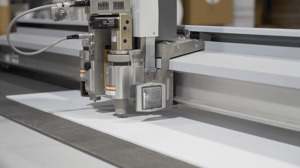
Using Grandma’s tin gingerbread man cutter works fine for the first dozen cookies, but it gets a little more complicated when you want to bake a million of them.
Although you may not be trying to build a veritable gingerbread man army, the same principles apply to your custom products. As your product scales, you’ll want to upgrade your converting method to maintain an efficient production.
As a converter, Strouse has seen everything, ranging from clients without machine capabilities to those who have already invested in highly advanced automation processes. Regardless of where you are currently, this article will teach you how to advance your current manufacturing processes to match your needs.
What are the Different Converting Methods?
Everyone begins their product development journey from a different place, and there are multiple avenues to consider.
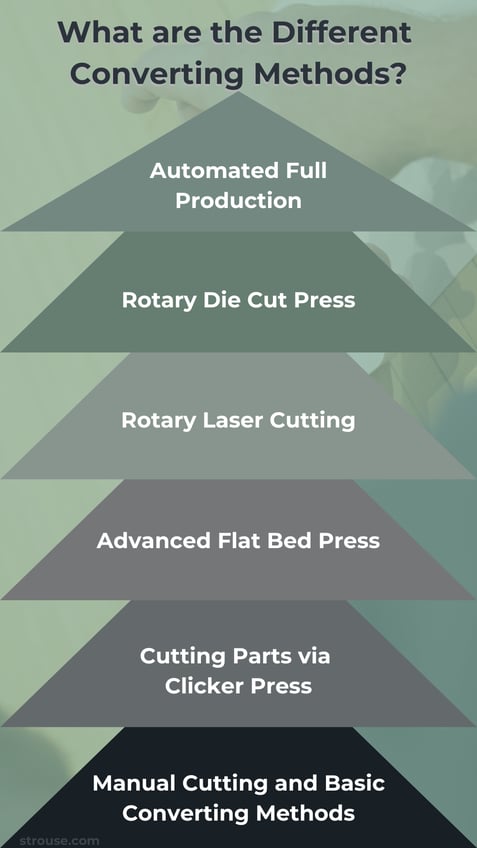
Although you probably won’t try EVERY converting process for one product, the latter options will become beneficial as you continue to scale. The options below are listed in order of lowest to highest throughput.
1. MANUAL CUTTING AND BASIC CONVERTING METHODS
Many prototypes originate from hand samples with no machine capabilities. Although accuracy and repeatability might be low, this is the first step of the material converting process.
Many companies also start out by using basic converting methods, such as a digital knife or a simple tabletop laser run, for initial prototypes with smaller quantities (<200 parts). These methods allow you to validate materials and designs before upgrading to larger-scale production processes.

2. CUTTING PARTS VIA CLICKER PRESS
The first throughput update for many is a clicker press, which uses a custom die to punch out shapes from materials. A simple clicker press is often a slow, 1:1 cutting method, where you essentially press a button, receive a part, and repeat the process. It requires a high level of manual labor and is generally inefficient for larger production runs.
3. ADVANCED FLAT BED PRESS
Flat bed presses are essentially modernized clicker presses. They can handle continuous rolls of material and are automated, allowing for material unwinding, rewinding, and part dispensing. Flat bed presses are far more efficient than the basic clicker press; however, more sophisticated options are available for complex parts requiring tight tolerances and/or higher quantities.
4. ROTARY LASER CUTTING
Laser cutting is ideal for projects with tight tolerance requirements. Laser cutting on a rotary press enables fast throughputs that outpace flat bed as far as quantity is concerned.
5. ROTARY DIE CUT PRESS
In the world of custom-cut flexible materials, rotary die cut parts often represent a fully scaled production process. Rotary die cutting is a rapid, highly efficient manufacturing method for large part quantities. While it typically isn’t cost-effective at smaller volumes due to setup time and material waste, rotary die cutting allows converters to build an effective one-pass production incorporating laminating, printing, cutting, and other processes into a single press run.
6. AUTOMATED FULL PRODUCTION
Automated production is the final boss of the converting world, so to speak. It could entail in-line packaging, pulling parts off a conveyor belt, specialized placement methods, and more. Automation can be an expensive process. Yet, despite the initial capital investment, these projects typically pay themselves off in just a few years based on the volume that they are outputting.
When is it Right to Upgrade?
Some projects linger in the early stages, while others fight to grow more quickly than is financially feasible.
If your business is doing well, and you are looking to grow it further, here are signs that it might be time to upgrade your converting process:
- You require extensive labor to complete parts.
- You’re unable to ramp up production volumes.
- Not enough parts in your desired timeframe
- Cannot meet the desired product releases or popular demand
When you know precisely what you want, how quickly you need it, and have an idea of future annual usage, you can advance your production process.
Remember that switching from one converting method to another may take weeks or even months, depending on which processes you are switching from and to. If you need to go to automated full production, plan for at least 6 months of R&D at minimum.
Upgrade to a More Efficient Process
It is easy enough to start manually cutting your product from rolls of material; however, when you need to start making thousands or even millions, a converter will help you hit specific volumes and quantities. They can help you select the right converting method for where you are at and where you want to go.

Get a quote to upgrade your converting process. We can provide quotes for a variety of quantities to give you a better estimate of how your project will scale.
Strouse also accommodates larger-scale runs over multiple shifts, and as your project expands, we can grow to match any additional resources needed. Our Capabilities page provides a better idea of our services and how we can help build your product.