.svg)

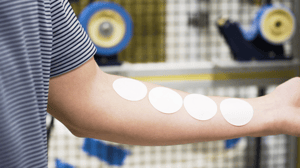
Although skin is the largest and outermost organ in your body, it is also considered one of the most delicate. This can create a challenge: skin adhesives that are too gentle may result in product failure, while those that are too strong risk injury to patients, especially elderly or infant patients with fragile skin.
Choosing the right adhesive for medical products means accounting for the wearability and overall performance. That’s why we’ve decided to compare the most common skin adhesion materials to see how they performed.
Through our experience working with medical device companies, we’ve found that most skin contact applications use either acrylic or silicone adhesives, especially for sensitive skin. Both have a wide range of options. So, for this test, we are not necessarily comparing brands but rather general categories of adhesives.
- Acrylic adhesive tape
- Short-term
- Long-term
- Silicone adhesive tape
- Short-term
- Long-term
In each of these cases, short-term refers to approximately 1 day of wear, while long-term refers to 1 week or more. To make our results as realistic as possible, three volunteers wore all four adhesives throughout their typical workdays to test comfort and removability.
By doing this test, we are looking to find which adhesive is easy to apply and remove without causing skin irritation while also being flexible and durable during the day. This way, you can have a better idea of how skin adhesives compare and make the best decision for your stick-to-skin application.
To figure out which material was best for a simple, one-day skin adhesive application, we principally observed the following factors:
- Ease of Application
- Removal
- Comfortability
- Overall performance
First, we assessed how easy each adhesive was to apply and the volunteers’ initial impressions.
|
I definitely think the silicone felt softer. I feel like it felt a bit more flexible and malleable than these two. The acrylic was a bit stiffer, which is pretty much to be expected. |
|
Definitely, initial thoughts are that you can tell that the acrylic versus the silicone is definitely more aggressive versus a gentler adhesive. Even when you flex the skin in the arm, the silicone definitely follows the skin, for lack of a better word, whereas the acrylic wants to stay in place as much as possible. |
Then, we sent our volunteers off to tackle a full day of work and see how the materials held up after eight hours of movement.
Eight hours later, it was time to bring everyone back in and test the ease of removal.
|
So here I’m taking off the short-term acrylic. Pretty pain-free. That is definitely not gentle. Honestly, I would be scared to take that off with hair underneath. |
|
And now I’m doing the short-term silicone adhesive here. That one came off really clean. That one didn’t really pull any skin. There’s not really any marks. So that one really reacted well. |
|
So I just took off the short-term acrylic and silicone. There’s already some redness. You can see the dots on my arms. It makes me worried for the long term. Basically, the acrylic was definitely harder to pull off. It was tougher and hurt a bit more. I think they’ve both perhaps stripped some hair, so we’ll just have to see how the next one is. |
|
All right, so this is the long-term acrylic adhesive. And again, that was a pretty clean release right there. It’s actually not too bad. |
|
Then this is the long-term silicone adhesive. And there it is. Not really any marks from that one either. That one’s a little bit difficult to grab a hand on, too. |
Once all of the adhesives were removed, we had everyone share their final thoughts on how everything performed.
|
I would say the short-term silicone was more comfortable during the day… the long-term silicone was also not too bad. I wasn’t sure whether it was because my sleeve was brushing against the acrylic or because it was closer to a more delicate part of my arm, but the acrylic was definitely slightly more uncomfortable. It felt a bit itchy because there wasn’t as much give when I flexed. |
|
I would say I really felt it. It was much more uncomfortable up here with the acrylics versus the silicones. I caught myself several times thinking about picking at it or itching it. The silicones, I felt their presence, but from a comfortability standpoint, I didn’t have a lot of discomfort there. The acrylic was definitely a little bit harder to take off, just like the short-term…All in all, it was simple, not painful at all. And then the silicone released really easily. No pain whatsoever, not even like a pull, really. |
|
I felt like the differences were more slight than I expected. I thought there would be a big difference between all of them when I was wearing them or upon removal, but really, other than a slight irritation from the stiffness of the acrylic and the surprising flexibility of the silicone, it was all pretty much very similar. I had to really focus to figure out what it felt like and what the differences felt like. |
Having assessed the application and removability of each adhesive, we pooled the information to reach a conclusion:
Silicone adhesives generally have a lower adhesive strength, making them gentler on skin. Acrylic adhesives provide stronger, longer-lasting bonds, which make them ideal for extended wear. However, that strength can increase the risk of skin irritation or damage if not chosen carefully.
In the end, both adhesives are similar, but still have their strengths and trade-offs. The key is matching the adhesive to your specific skin contact application and patient needs.
If you’d like to learn more about stick-to-skin adhesives or how a converter like Strouse can help bring your medical product to life, check out our Learning Center or reach out to us directly.